Startup
RAIC Labs to launch revolutionary AI tool: RAIC Foundry
RAIC Labs, formerly known as Synthetaic, is pioneering artificial intelligence (AI) solutions that eliminate traditional barriers to AI model development. The company, headquartered in Delafield, Wisconsin, was founded in 2019 by engineer and inventor, Corey Jaskolski.
RAIC (pronounced ‘rake’)—short for Rapid Automatic Image Categorization—is an AI-based technology that quickly harnesses the power of AI without the need for specialized technical skills or massive amounts of training data. The company made international headlines in 2023 when it used RAIC to track the Chinese spy balloon around the globe.
The pioneering technology company has raised $33.4 million in venture capital funding and secured a strategic partnership with Microsoft that provides the company with nearly 1 million hours of cloud compute resources. That partnership promises to “unlock a new era of possibilities in computer vision and data analysis, with a wide range of benefits across defense and intelligence, commercial, and non-government agency applications.”
Now, RAIC Labs is preparing to take its technology even further with the launch of RAIC Foundry in Q2. In advance of the launch, Jaskolski, the firm’s Founder and CEO, spoke with MKEStartup.News (MSUN) about the company’s mission, its latest innovations, and what’s next for RAIC Labs.
MSUN: What does RAIC Labs do?
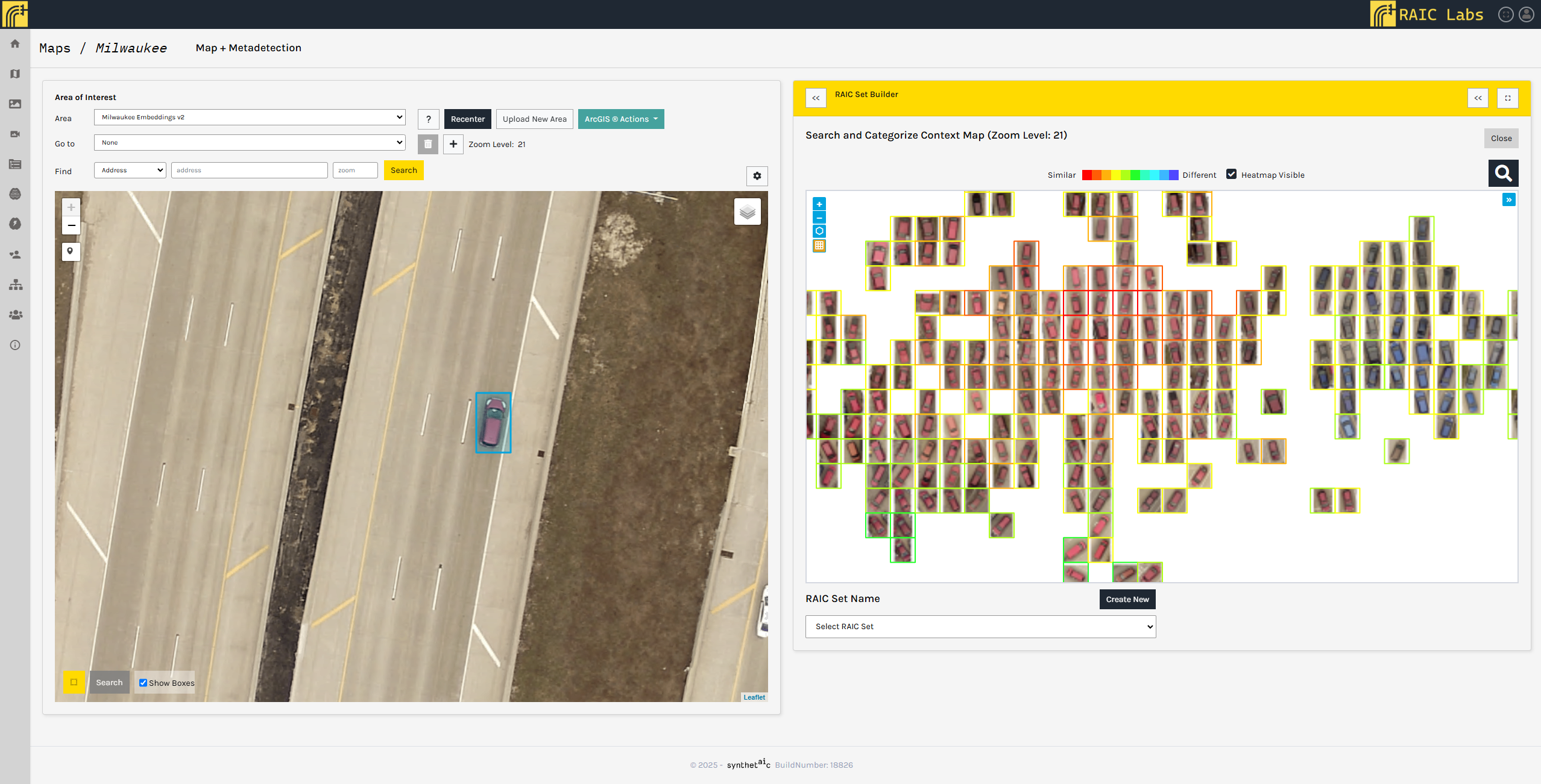
Jaskolski: We’ve developed a new way to build AI models that doesn’t require massive amounts of human-labeled data or huge computing overhead. We’ve been selling this technology in both government and commercial markets, and now we’re rolling out a new product called RAIC Foundry. This will allow our customers to access the mathematical space behind our models, making AI more accessible and customizable.
MSUN: What kind of expertise does someone need to use RAIC Foundry?
Jaskolski: The developer side is aimed at AI professionals, software developers, and cloud engineers. But we’re also building an application layer that doesn’t require technical expertise. Users will be able to point it at data and use a guided interface to train AI models in a few steps—without needing thousands of labeled images like traditional AI. You can show it just a few examples, and it figures out the rest.
MSUN: That sounds like a huge step in democratizing AI. Is that how you see it?
Jaskolski: Absolutely. That was the core frustration that led me to start this company. I almost dropped out of MIT’s AI program because I couldn’t believe we had to do all this tedious human labeling to train AI models. Our approach lets people who don’t have massive AI budgets access powerful AI tools in a cost-effective way.
MSUN: Can you share some real-world applications of your technology?
Jaskolski: One of the biggest examples was using RAIC to track the full flight path of a suspected Chinese spy balloon. We scanned 18 trillion pixels of satellite imagery in just two minutes, using only a rough sketch. Our technology has also been used by CNN to analyze war zones, by The Nature Conservancy for environmental tracking, and even by astronomers searching for dark matter.
MSUN: When will RAIC Foundry be available to the public?
Jaskolski: We’re planning to launch it in early April. It’ll be a pay-per-use model with subscription options to keep it affordable, especially for smaller businesses and organizations.
MSUN: What’s next for RAIC Labs?
Jaskolski: We’re focused on making AI more accessible across industries. Many organizations assume AI is too complex or expensive, but we’re proving that’s not the case. We’re also proud to be doing this in Wisconsin. People told me I had to move to Silicon Valley to start an AI company, but we’ve built an amazing team here, hiring talent from UW-Madison, Marquette, and IIT. We’re showing that high-tech innovation can thrive in the Midwest.
With RAIC Foundry set to launch in April, RAIC Labs is positioned to continue reshaping the AI industry. By removing barriers to AI adoption, the company is ensuring organizations of all sizes can harness the power of artificial intelligence for real-world problem-solving.